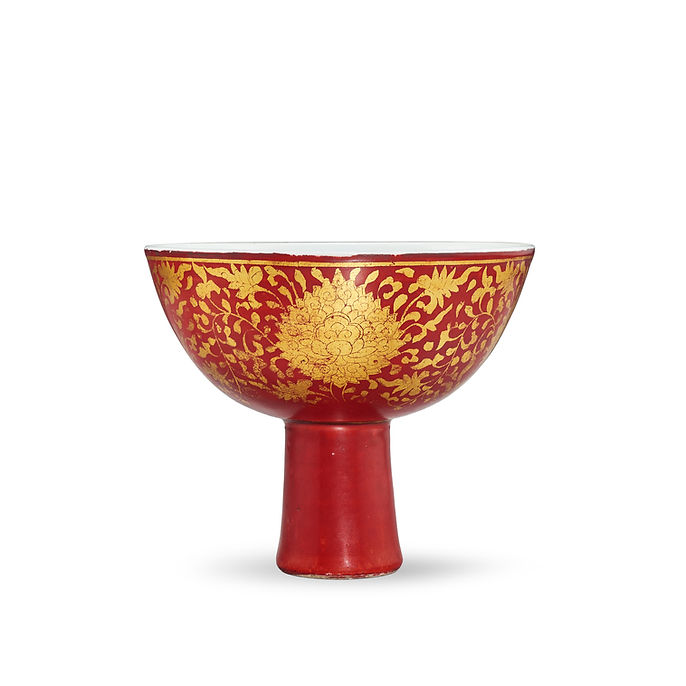
PORCELAIN KINRANDE STEM BOWL
MING DYNASTY, JIAJING PERIOD (1522-1566)
11 cm high, 13.4 cm diameter
The bowl is of wide hemispherical shape, supported on a tubular stem slightly splaying towards the base. The white porcelain body is covered in a clear glaze, the exterior painted with an iron-red ground decorated in gold with four large lotus blooms surrounded by dense foliage. The underside of the bowl shows traces of a petal lappets border. The interior of the bowl is left white.
The Japanese term kinrande (‘gold brocade work’) refers to silhouette decoration using gold leaf, which was used for only a short period during the reign of emperor Jiajing. The technique entails using a brush and a liquid adhesive to which the gold would adhere to paint the decoration over an enameled background. The decoration would then be incised with details using a fine pointed tool, revealing thin lines of the enameled body to come through the gold leaf. Kinrande porcelains were particularly treasured in Japan by tea masters and collectors. Several objects for use in the tea ceremony survive, however, stem bowls like the present one are rare. For a similar stem bowl in the collection of the British Museum see Jessica Harisson-Hall, Ming Ceramics in the British Museum, London, 2001, plate 9:86, p. 247. A further stem bowl with very similar decoration, formerly in the Meiyintang Collection, is published in Regina Krahl, Chinese Ceramics from the Meyintang Collection, London, 1994-2010, vol. 4, no. 1684.
Kinrande porcelains also appear in old European collections, often adorned with precious metal mounts, see Encompassing the Globe. Portugal and the World in the 16th and 17th Centuries, Arthur M. Sackler Gallery, Washington D.C., 2007, cat. no. 64-66.
Provenance:
Watanabe & Co., Ltd, Tokyo
Formerly in the collection of Mr. Hikonobu Ise (b. 1929)
Published:
Christian Boehm, A Tea Master’s Vision: Chinese Ceramics from the Ise Collection, Arts of Asia, July-August 2018, fig. 27.
Porcelaine, Chefs-d'Oevre de la Collection Ise, Musee Guimet, 2017, pl. 43, p. 128.
Ise Korekushon Sekai wo Miryoshita Chugokutoji / The Enchanting Chinese Ceramics from the Ise Collection, Museum of Oriental Ceramics, Osaka, 2017, cat. no. 55.
Shika Meisai: Ise Korekushon no Meito / Imperial Colors: Peerless Chinese Porcelains from the Ise Collection, Gotoh Museum, Tokyo, 2015, cat. no. 13.